

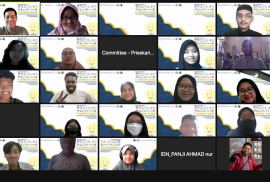
The Summer Course organized by the Faculty of Agricultural Technology UGM has entered its 3rd day on Wednesday, August 10, 2022. The series of events on the third day started at 06.45, which started with an opening by the presenter. Then continued with the first session, namely the presentation of material by Prof. Tsuyoshi Okayama. After the first session ended, it was followed by a Virtual Field Trip and group discussion. The second session started at 10.00 and was hosted by Dr. Nathdanai Harnkarnsujarit. After the break session, the presentation of the material was continued by Prof. Hitoshi Shirakawa at 13:00 as the third session. Today’s activity ended with a material presentation from Dr. Shivani Pathania at 15.00.
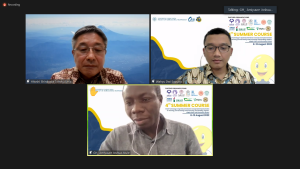 The first session was presented by Prof. Tsuyoshi Okayama, entitled Smart Agriculture Implementation in Japan. In this session, accompanied by Dr. Mirwan Ushada, S.T.P, M.App.Life Sc. as a moderator, Prof. Tsuyoshi explained the agricultural situation in Japan, agricultural machines with autopilot technology, and drone functions in Japan. Japan is experiencing a decrease in the number and aging of farmers, with an increase in the area of ??land per farmer each year. The development of smart agriculture consisting of automation of agricultural machines, agricultural management systems, and 5G internet can ease the workload of farmers and increase the quality and quantity of production. In addition, Prof. Okayama also presented about robots and agricultural services used by Japan. The robot shown is a robot that is used to cut grass and harvest asparagus using image recognition. The agricultural service presented was Raas, a service robot that aims to be rented and paid for according to the harvested production.
Before moving into the next sessions, participants are welcome to see a virtual field trip with the theme of modernization of irrigation. This virtual field trip shows the irrigation conditions in the Bedegolan area, which have been modernized using SIPASI, an application for a decision support system. The data from the automatic water level monitoring system and automatic weather station are collected and sent to SIPASI using IoT technology. Farmers use the data obtained to estimate water requirements for land irrigation. After seeing the footage of the field trip, the participants were divided into several breakout rooms according to their respective groups. In the breakout room, the participants discussed the topic of a virtual trip, then each group of participants would make a presentation on the discussion results.
The second presentation was given by Dr. Nathdanai Harnkarnsujarit with the title Sustainable Packaging Technology for Agricultural and Food Products in Modern Living with Dr. Manikharda, S.T.P., M.Agr as moderator. Dr. Nathdanai explains that designing packaging requires a combination of art and science. Art is used to combining colors, layouts, and images to produce attractive packaging. Science determines the best material for a particular product by considering the reactions between the packaging and the product. Packaging has several uses: providing information, transporting, storing, and protecting products. Packaging can extend the product’s life by using active agents to prevent the product from oxidizing. Even so, products and packaging are expected to be more durable and environmentally friendly to reduce packaging waste. Packaging waste can cause climate change and global warming. Recycling, reducing use, reusing, making compost, and using bioplastics is the solution to reducing packaging waste.
In the third session, Prof. Hitoshi Shirakawa explained the material about Rice Bran as a Functional Food: An Overview of The Conversion of Rice Bran into a Superfood/ Functional Food. This session was moderated by Wahyu Dwi Saputra, S.T.P., M.Agr.Sc.,Ph.D. Prof. Shirakawa, in this session, explained that In Japan, the rice brain is used for the production of rice oil (37,5%), feed for livestock (7%), mushroom cultivation (9,5%), and others (46%). Prof. Shirakawa also explains the process of rice bran oil and its by-products: lecithin, ceramide, inositol, phytic acid, rice bran protein, ?-oryzanol, ferulic acid, phytosterol, triterpene alcohol, tocopherol, tocotrienol, and rice oil. In summary, we know that FRB supplementation reduces muscle atrophy in diabetic muscle atrophy by partially preventing muscle size reduction. FRB supplementation reduced the activation of NF-kB and interfered with the TNF-? feedback loop that may exacerbate its activation, resulting in the decrease of FBXO32/atrogin-1 and TRIM63/MuRF1 protein levels. And also, the functional components in FRB act as anti-inflammatory agents, which may ultimately result in a protective effect against muscle atrophy in diabetic complications.
The last session by Dr. Shivani Pathania on the topic of New Product Development and Food Packaging Solutions. In the session led by Ashri Nugrahini, S.T.P., M. Sc., Dr. Shivani explained that product and packaging innovation continues to grow. The development of packaging and food can give food a longer life and reduce food waste. Examples of these innovations are various packaging seals such as tray sealing, form sealing, thermoforming, cartons, form sealing, and can seaming. In addition, packaging design methods such as UC bowl, flow pack, and downgauging are packaging design methods by reducing plastic and are environmentally friendly.
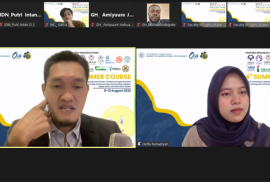
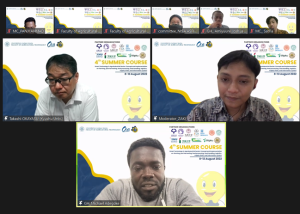 The fourth session which was also the last session was presented by Asst. Prof. Ravipim Chaveesuk. Mrs. Ravipim presentation entitled “The Implementation of Computational Intelligence (Neural Network and Fuzzy Logic) in the Agricultural System”. This session was accompanied by Mr. Imam Bagus N, S.Si. M.Sc. as a moderator. Mrs. Ravipim explained data analytics is the process of analyzing raw data to extract actionable information and insights. There are three components of data analysis such as business knowledge; mathematics, statistics, data visualization, machine learning, deep learning; and programming. In addition, data analytics has stages depending on the level of difficulty and value. They are Descriptive, Diagnostic, Predictive and Prescriptive Data Analytics. Descriptive data analysis is considered past data to answer what happened which generally considers one variable. Data diagnostics is to consider past data and analyze it. Predictive data analytics uses past data to predict what will happen tomorrow or in other words what to expect. And finally, prescriptive data analytics is making decisions. Some big data are known as 3V such as volume, speed, and variation. Data analysis is typically used by these top sectors such as marketing, sales, social media, credit and insurance, and manufacturing.