• About UGM
  • Academic Portal
  • IT Center
  • Library
  • Research
  • Webmail
  • English
    • Indonesia
    • English
Universitas Gadjah Mada Universitas Gadjah Mada
Faculty of Agricultural Technology
  • Home
  • About Us
    • History of Faculty
    • Vission and Mission
    • Dies Natalis
    • Goals and Objectives
    • Institution Structure
    • Faculty Management
    • Facilities
      • Library
      • Laboratory
    • Lecturer Staff
    • Cooperation
    • Contact
  • Education
    • Department
    • Study Program
    • Graduate & Postgraduate Program
    • Accreditation
    • Academic Calendar
    • SUMMER COURSE
    • Fast Track Program
  • Research
    • Journal
    • Books
  • College Student
    • Information
    • Student Services
    • Student Organizations
    • Internship
    • Scholarship
  • Alumni
    • List of Graduates
    • Career
    • Tracer Study
  • Home
  • Post by
  • (Page 7)
Post by :

luqlun.ma

Smart Farming and Technology for Agricultural Products

EducationNews ReleaseStudentSummer Course Wednesday, 9 August 2023

On August 9th 2023, Summer course entered it’s third day. On the third day, there are 4 session, the first one is the first session presented by Andri Prima Nugroho, S.T.P., M.Sc., Ph.D and moderated by Dr. Deffa Rahadiyan, S.Si. Second session presented by Dr. Phumon Sookwong and moderated by Lulum Leliana, S.T.P.  Third session presented by Dr. Jahidul Islam and moderated by Wahyu Dwi Saputra, S.T.P., M.Agr.Sc., Ph.D. and lastly the fourth session presented by Dr. Stuart Coles and moderated by Ardhika Ulfah, S.T.P., M.Sc.

The third day of the 5th Summer Course started at 07.15, which started with an opening by the master of ceremonies. Then continued with the first session presented by Andri Prima Nugroho, S.T.P., M.Sc., Ph.D and moderated by Dr. Deffa Rahadiyan, S.Si. The topic of the first session was Smart Agriculture to Support Food Security: Study Case in Indonesia. There are 3 outlines which are the topic of this session. The first is Introduction to Precision Agriculture and Smart Agriculture. The second is Framework of Revolusi Industry 4.0 and Society 5.0. And the last one is Case Studies of Implementation of Smart Agriculture in Tropics – From Research to Industries and Communities. After the first session ended at 9 o’clock, participants continued the Independent Study on eLOK around 1 hour.

At 10 o’clock, the third day of the 5th Summer Course entered the second session. The second session presented by Dr. Phumon Sookwong and moderated by Lulum Leliana, S.T.P. Dr. Phumon Sookwong eplained the material about Food and Oleo Chemistry of Rice and Cereals. in this session Dr. Phumon Sookwong explained about bioactive compounds in rice. One of the bioactive compounds in rice taught by Dr. Phumon Sookwong is tocotrienol. Dr. Phumon Sookwong also said that pigmented rice is healthier than regular rice. Pigmented rice contains bioactive compounds such as anthocyanins which are beneficial for health.
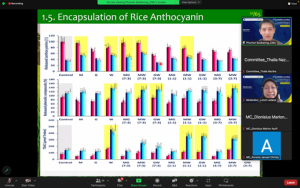
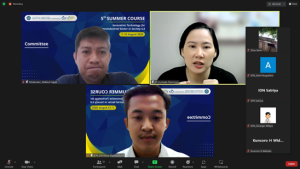
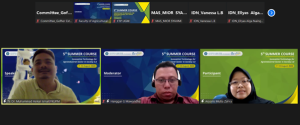
Speakers and material presented in the second session

In this third session, the material for the summer course was delivered by Dr. Jahidul Islam and moderated by Wahyu Dwi Saputra, S.T.P., M.Agr.Sc., Ph.D. The topic of the third session material is Fecal Microbiota Transplantation for livestock animals wellbeing. On this topic Dr. Jahidul Islam explained about Fecal Microbiota Transplantation (FMT) which is another way to treat diseases such as diarrhea without using antibiotics. FMT works by making a balance between gram-positive and gram-negative bacteria and changing the microbiome to a balanced condition. There needs to be further research on FMT to get the percentage of the probability of success. Does not rule out that FMT can be used for other purposes in the future.
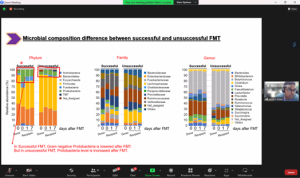


Speakers and material presented in the third session

The fourth session which was also the the last session on the 3th day of summer course is presented by Dr. Stuart Coles and moderated by Ardhika Ulfah, S.T.P., M.Sc. The topic in this last session is Utilisation of Waste Cooking Oil in Polymers and Composites for the Automotive Sector. Topic of discussion focus on vegetable oil as a renewable feedstock, a versatile and abundant or flexible chemical platform. On this topic Dr. Stuart Coles explained waste oil formulations could be optimized to promote bio-based content in the future.

At the end of this day, all the participants do the post-test at UGM’s E-Learning system (e-LOK). Then, the participants can continue the discussion with their group work and do independent study such as material review on this day and essay writing submission. They have to prepare for the fourth day and always check all of the assignments at e-LOK.
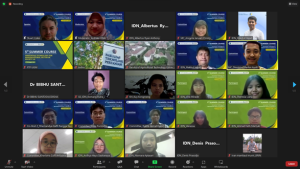
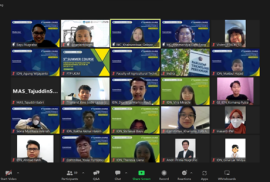
All the participants on fourth session.

Technology for Development and Implementation in Agricultural Products

EducationNews ReleaseStudentSummer Course Wednesday, 9 August 2023

The 5th Summer Course’s second day held on Tuesday, August 8th, 2023. The first session was opened by Dr.Eng. Herianto, S.T., M.Eng., IPU., ASEAN Eng. from Faculty of Engineering, Universitas Gadjah Mada as a national speaker. The main topic of the speaker is 3D Printing for Chocolate. The process of 3D printing is made layer by layer or additive manufacturing. 3D printing is started with a CAD model and then transformed into a 3D object in some steps and techniques. The participants were so enthusiastic and it showed in a question-and-answer session. The participant and the speaker discussed the 3D food printing treatment if there are any characteristics. The speaker talked more about the treatment of 3D food printing according to the material, compounds. It brings a different process, different material, so different machines to create the 3D printing product. The conclusion from Mr. Herianto is that the technology of food printing can represent a remarkable innovation because the potential of the technology can revolutionize various aspects of the culinary and food industry and also can anticipate a future where it has a pivotal role in producing, consuming, and experiencing food.

After the first session, the participants joined the breakout room to discuss with their group. The topic of discussion is commodity or industry and gives ideas of technology innovation that can bring up and push the agroindustrial sector in society 5.0. All the participants were divided into 12 groups. All groups have approximately 30 minutes to discuss and brainstorm their topic. In this discussion session, the participants can develop their analytical thinking skills to brainstorm and analyze the idea from the perspective of its strengths, weaknesses, opportunities, and threats of the technology.

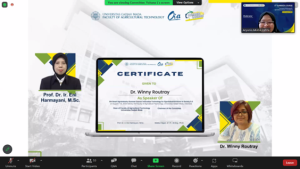
The series on the second day of the 5th Summer Course is continued by the second session speaker from Dr. Winny Routray from National Institute of Technology of Rourkela. The main topic discussed in this session is food engineering and post-harvest processing of spices. This topic is talked about spices, which is a product that has a lot of functions such as adding flavor and scents to foods. The product is made from spices such as essential oil. The highest exporters of spices are India, Vietnam, China, Indonesia, and Madagascar, while the highest importers of spices are USA, Germany, and Vietnam. Another important part of optimizing spices products is the packaging. The packaging must consider moisture, oxygen, aroma loss, hygroscopic in nature, pest attack, and weeds in the rainy season. The packaging may contain polyethylene linen and double gunny for bulk packaging. To sustain the production of the spice in the field, some toxins can affect the product such as mycotoxin (ochratoxin), and factors from pre-harvesting, harvesting, and post-harvesting. The solution by the advanced processing method of whole spices, spices powder, and paste such are the drying process using microwave and sterilization process using gamma rays, hydrostatic high pressure, and low-pressure cold plasma. This second session is closed by the certificate submission documentation with the speaker.

Certificate Submission Documentation with The Speaker (Dr. Winny Routray)

The lecture was continued by Dr. Suchada Rianmora from SIIT, Thammasat University, Thailand. The main topic in this session is the product design approach for the agroindustrial sector. The speaker explained that the key considerations of product design and development are to set up “the reference” situation, identify “key components or objects”, and create “a conceptual design” by starting a new journey of product design and development. Also, the participants have new insight and knowledge about developing products and minimizing the gap between high technology and the user in reality. In the processes to develop product design, there are some tools and equipment that can be used such as robots, remodifying and development, and supporting customer satisfaction. Implementation in reality we can do a site survey to take examples and find the case studies. The conclusion in this topic is we should understand and know what the customer needs or should be customer-centric. After that, some participants offered some questions to be discussed with Dr. Suchada Rianmora. All of the elaboration from the speaker gives more perception to the participants.

Questions and Answer Session with Dr. Suchada Rianmora

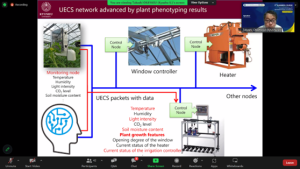
The last session on the second day of the 5th Summer Course was filled by Prof. Takashi Okayasu, Ph.D. from the Department of Agroenvironmental Science, Faculty of Agriculture Kyushu University. The main topic is talked about plant phenotyping technology to promote data-driven agriculture. Moreover, this topic is UECS network advanced by plant phenotyping results which are correlated between the monitoring node (temperature, humidity, light intensity, CO2 level, and soil moisture content) and plant phenotyping sensor node (image analysis). The system also has connections with a window controller, heater, and irrigation controller. Each connection has a control node and was integrated.


Last Session on Second Day of 5th Summer Course

At the end of this day, all the participants do the post-test at UGM’s E-Learning system (e-LOK). Then, the participants can continue the discussion with their group work and do independent study such as material review on this day and essay writing submission. They have to prepare for the third day and always check all of the assignments at e-LOK.
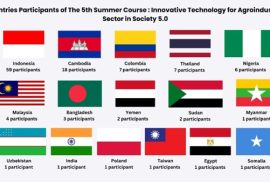
Participants from 16 countries attend the 5th Summer Course

EducationNews ReleaseStudentSummer Course Monday, 7 August 2023

The Faculty of Agricultural Technology Universitas Gadjah Mada is organising the 5th Summer Course this year. This event will be held from 7th August to 13th August 2023. The theme of this summer course is “Innovative Technology for Agroindustrial Sector in Society 5.0”. The 5th Summer Course will be held online synchronously system through Zoom meetings and online asynchronously system through UGM’s E-Learning system (e-LOK). The grand opening of this summer course held on 7th August 2023 by opening statement from Makbul Hajad, S.T.P., M.Eng., Ph.D. as the Chairman of the Committee, Prof. Dr. Ir. Eni Harmayani, M.Sc. as The Dean of Faculty of Agricultural Technology, Universitas Gadjah Mada, and Dr. Puji Astuti, S.Si., M.Sc., Apt. as the Director of Partnerships and Global Relations, Universitas Gadjah Mada.

The 5th Summer Course has 24 sepakers, 15 international and 9 national. The speakers who have been invited are as follows:

  1. Prof. Dr. Ir. Lilik Sutiarso, M. Eng. from Faculty of Agricultural Technology Universitas Gadjah Mada;
  2. Prof. Yu Pin Lin from Bioresources and Agriculture college at National Taiwan University;
  3. Ts. Dr. Muhammad Heikal Ismail from Universiti Putra Malaysia (UPM) Serdang;
  4. Dr. Eng. Herianto, S.T., M.Eng., IPU., ASEAN Eng from Faculty of Engineering, Universitas Gadjah Mada;
  5. Dr. Winny Routray from National Institute of Technology of Rourkela;
  6. Assoc. Prof. Dr. Suchada Rianmora from SIIT, Thammasat University, Thailand;
  7. Prof. Takashi Okayasu, Ph.D. from Department of Agroenvironmental Science, Faculty of Agriculture Kyushu University;
  8. Andri Prima Nugroho, S.T.P., M.Sc., Ph.D. from Faculty of Agricultural Technology Universitas Gadjah Mada;
  9. Dr. Phumon Sookwong from Chiang Mai University;
  10. Dr. Jahidul Islam from Tohoku University;
  11. Dr. Stuart Coles from WMG, University of Warwick;
  12. Rachma Wikandari, S.T.P., M.Biotech., Ph.D. from Faculty of Agricultural Technology Universitas Gadjah Mada;
  13. Prof. Dr. Ir. Endang Sutriswati Rahayu, M.S. from Faculty of Agricultural Technology Universitas Gadjah Mada;
  14. Assoc. Prof. Dr. Santad Wichienchot from Prince Songkla University;
  15. Shivani Pathania, Ph.D. from Tegasc, Ireland;
  16. Riza Arief Putranto, Ph.D. from Indonesian Research Center for Biotechnology and Bioindustry;
  17. Andi Patiware Metaragakusuma, Ph.D. from Research Institute for Humanity and Nature (RIHN), Japan;
  18. Prof. Tsai Chi Kuo from Department of Industrial Management, National Taiwan University of Science and Technology;
  19. Assoc. Prof. Pornthipa Ongkunaruk, Ph.D. from Kasetsart University;
  20. Prof. Dr. Eng. Kuwat Triyana, M.Si. from Faculty of Mathematics and Natural Sciences Universitas Gadjah Mada;
  21. Dr.rer.nat. Andri Frediansyah, S.Si., M.Sc. from Research Center for Food Technology and Processing, National Research and Innovation Agency (NRIA – BRIN);
  22. Prof. Kune MuhTsai from National Kaohsiung University of Science and Technology Management College;
  23. Dr. Edita Jurak from Faculty of Science and Engineering, The University of Groningen;
  24. Prof. Dr. Kuncoro Harto Widodo, S.T.P., M.Eng. from Faculty of Agricultural Technology Universitas Gadjah Mada.

There are 115 final participants joining this 5th Summer Course, 59 participants from Indonesia; 18 participants from Cambodia; 7 participants from Colombia; 7 participants from Thailand; 6 participants from Nigeria; 4 participants from Malaysia; 3 participants from Bangladesh; 2 participants from Yemen; 2 participants from Sudan; 1 participant from Myanmar; 1 participant from Uzbekistan; 1 participant from India; 1 participant from Poland; 1 participant from Taiwan; 1 participant from Egypt; and 1 participant from Somalia. The participants joined to create and collaborate in group discussions and visit and explore Indonesia virtually.

On the first day, there are three speakers, the first one is Prof. Dr. Ir. Lilik Sutiarso, M. Eng. from Faculty of Agricultural Technology Universitas Gadjah Mada who gave the material “Implementation of Smart Agriculture Concept Based on Integrated Farming”. The topic is about how to design smart technology for agriculture in Indonesia, especially society 5.0 to become a smart society. Moreover, the speaker just not talks about productivity, but also talk about sustainability and engineering. The conclusion of the topic is we have to know the agriculture character system and the key to success is collaboration, not done individually but must work together.


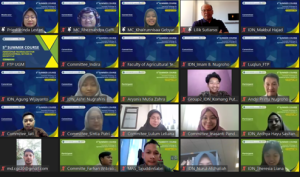
Figure 2. First Session: Documentation with Speaker (Prof. Dr. Ir. Lilik Sutiarso, M. Eng.) and All Participants

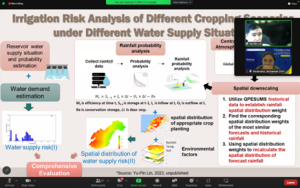
After that, the second session is Prof. Yu-Pin Lin from Bioresources and Agriculture College at National Taiwan University who gave the material “Food Water Nexus in Adaptation to Impacts of Climate Change”. The topic is about the global agriculture challenge under climate change agricultural water management. Furthermore, risk assessment of crop suitability is important and there are adaptation strategies for the risk of crop cultivation. The conclusion of the topic from Prof. Yu-Pin Lin is the integration of crop rotation with water supply risk is effective thinking to mitigate climate change impacts.

Figure 3. Second Session: Presentation from Prof. Yu-Pin Lin

The last one for the first day is Ts. Dr. Muhammad Heikal Ismail from Universiti Putra Malaysia (UPM) Serdang who gave the material “Technology for Food Waste Valoration”. The topic is about food hierarchy and sources of prevention such as food recovery, repurposing, and incineration of landfill. In conclusion from Ts. Dr. Muhammad Heikal Ismail is a properly managed food waste causing environmental inconvenient that can nurture the earth by recovering its nutrient.


Figure 3. Third Session: Question and Answer Session with Speaker (Ts. Dr. Muhammad Heikal Ismail)

Finally, at the end of the first day 5th Summer Course was closed by doing the post-test for the participants, integrated collaborative or group work, and independent study such as material review and essay writing.

Management and Supply Chain in Agroindustry

EducationNews ReleaseStudentSummer Course Monday, 15 August 2022

The Summer Course organized by the Faculty of Agricultural Technology UGM has entered its 5th day on Friday, August 12, 2022. The series of events on the third day started at 08.00 (GMT+7) and finished at 17.00 (GMT+7). In the fifth day, we discussed about Management and Supply Chain. There four sessions that deliverd by Mr. Henri Suhardja, Dr. Atris Suyantohadi, S.T.P., M.T, Assoc. Prof. Sastia Prama Putri, Ph.D, and Prof. Christine Hung. 

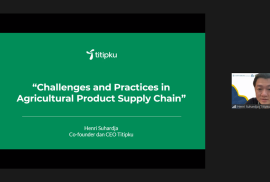
The first session was delivered by Mr. Henri Suhardja with Challenges and Practices in Agricultural Product Supply Chain as the topic. As a founder of Retail Start Up Titipku, he explained how his platform solved agricultural supply chain problems. He told us that Titipku  help merchant sell online, like Instacart, by bringing customers traffic and providing personal shopper for delivery services. Beside that, Titipku helps merchant organize better order and payment, also help merchant get access to cheaper inventory and capital.

The second session we discussed about Smart Agricultural Enterprise Development from Soybean Farming, Post Harvesting and Agroindustry of Tempeh. This session was delivered by Dr. Atris Suyantohadi, S.T.P., M.T. He explained to us that Indonesia is the origin producer of tempeh, but ironically soybean productivity in Indonesia only on the average number. To increase national soybean productivity system, there are development ideas such as implementing modern technology on soybean production and develop the collaboration between farmers and multinational industry. As a Founder of Attempe Agroindustry, Dr. Atris also showed us tempeh production process. Tempeh is already known worldwidely because of its delicious tastes and nutritions. Tempeh may also the commodity key for Indonesia’s lacking economy solution. Nowadays, tempeh industries are still a small scale household industry. But in the future, as young generation, it is our hope and duty to make tempeh industries go globally.

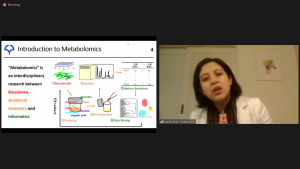
The third session was delivered by Prof. Sastia with Metabolomics Application to Solve the Problem of Food Loss in Supply Chain as the topic. She explained to us how metabolomics solved food loss with its interdisciplinary research between bioscience, analytical chemistry and informatics. The application of metabolomics for food production such as investigating the cause of disease in plant or aquaculture products, aid systematic and make postharvest management become effective also best to quality improvement. Metabolomics also can be applied to various food products such as natural food products or processed/fermented food products. The food metabolomics application can be used for component analysis, quality improvement, authenticity assessment and diet monitoring.

The last session was delivered by Prof. Christine Yung Hung, Ph.D. The topic was about Consumer Behavior and Marketing Analytics. She explained to us that studying consumer behavior is important because it can assess consumers’ needs and wants and also can understand the impact of health and sustainability. She told us that variation size of a beverage package is marketing strategy so one of the size can chosen more often when consumers compromise the options and it called the compromise effect. She also taught us about other marketing theory and analysis through many study cases, so we could understand the topic thoroughly.
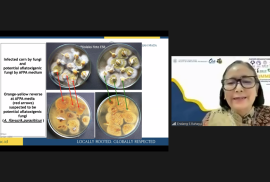
Smart Food Analysis

EducationNews ReleaseStudentSummer CourseUncategorized Sunday, 14 August 2022

On August 12th 2022, Summer course entered its fourth day. On the fourth day, there are 4 main events, the first one is the first session by Dr. Widyastuti Setyaningsih, S.T.P., M.Sc. Second session by Prof. Dr. Ir. Endang Sutriswati Rahayu, M.S. Third session by Prof. Miguel Palma and lastly the fourth session by Asst. Prof. Thanit Puthpongsiriporn, Ph.D.

The series of events on the fourth day started at 07.55, which started with an opening by the master of ceremonies. Then continued with the first session by Dr. Widyastuti Setyaningsih, S.T.P. with “Application of experimental designs to develop analytical methods for bioactive compounds in foods”  as topic. This session was also accompanied by Ashri Nugrahini, S.T.P., M. Sc.. Dr Widyastuti starts the topic with how bioactive compounds in rice can be separated with chromatographic methods. And then this method can be replaced with other experimental designs. The experimental design can be applied using analytical extraction techniques, namely MAE and PLE and analytical separation techniques, namely HPLC-PDA and UPLC-PDA-FD.
The second lecture was given by Prof. Dr. Ir. Endang Sutriswati Rahayu, M.S. entitled “Control Technology Against Contaminants Using Beneficial Microorganisms To Improve The Quality Of Food”. This session started at 10.00 AM GMT +7 and this session also was accompanied by Ardhika Ulfah, S.TP., M.Sc. as a moderator. She began her lesson by explaining that the keyword for her lecture is contaminant (mycotoxin) and beneficial microorganism (lactic acid bacteria). Mycotoxin like aflatoxin can contaminate food, affecting health and giving a bad effect in growth like stunting, underweight, and another growth problem.Microorganisms can be used to control mycotoxin and it’s also environmentally friendly if we compare it to pesticides.  Lactic acid bacteria (LAB) is one of the microorganisms that can be used. LAB is capable of binding aflatoxins and also can prevent the growths of bacterial toxins and their producers.

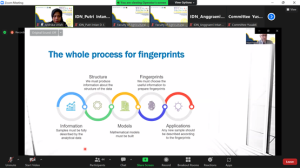
In the third session, Prof. Miguel Palma explained the material about Chemometric Tools in Food Analysis : from Numerical Data to Fingerprints. This session was moderated by Ardhika Ulfah, S.T.P., M.Sc.. Prof. Miguel Palma, in this session begins with an explanation regarding the analysis of the web browser’s working system so that it can meet the needs of its users through the collection of user behavior data. This can be applied to the food industry by collecting data so that fruit or vegetables can be sorted without touching or damaging them based on an existing data base. Another use in the food industry is that fingerprints enable simple, fast, and automated answers that can assist identification and quality control in food companies.

The fourth session which was also the the last session on the 4th day of summer course is held by Asst. Prof. Thanit Puthpongsiriporn, Ph.D. With the topic “Food Product Traceability Smart Technology in Agro Industrial Sector (Concept and Implementation”. Traceability is an ability to identify the past or current location of an item as well as to know the item’s history. There are some  traceability technologies which can be different depending on its fundamentals, the example is unique identification, automatic data capturing and data sharing. The main objective of traceability is to give evidence of food safety. Increasing customer services and cost reudition.

1…5678

Recent Posts

  • Three DTPB FTP UGM Study Programs Secure ASIIN International Accreditation Through 2030
  • Dari Benih hingga Lahan, FTP UGM dan Sang Hyang Seri Kembangkan Teknologi Pertanian Berbasis Data
  • Learning Across Cultures at Jeonbuk National University, South Korea
  • Beautiful Learning Journey: A Student Exchange at JBNU, South Korea
  • My Experience at Khon Kaen University (TPHP Student Mobility Program)

UGM News

  • UGM’s Youngest Doctoral Graduate Advances Native Chicken Genetics
  • UGM and NTU Host ASEAN Summer School on Renewable Energy and Smart Cities
  • Black Aromatic Ginger and Gotu Kola: UGM Study Finds Potential Herbal Therapy for Optic Nerve Inflammation
  • UGM Researcher Finds Potential Antioxidant and Antihypertensive Benefits in Goat and Sheep Skin Collagen
  • UGM Promotes Green Dentistry Through Free Dental Checkups and Oral Health Education
Universitas Gadjah Mada

UNIVERSITAS GADJAH MADA
FACULTY OF AGRICULTURAL TECHNOLOGY
Jl. Flora No. 1 Bulaksumur
Yogyakarta, Indonesia 55281
+62 274 589797
+62 274 589797
fateta[at]ugm.ac.id

Faculty Information

  • News Release
  • Event
  • Academic
  • Scholarship
  • Job Vacancy
  • Grant

Department

  • Food and Agricultural Product Technology
  • Agricultural Engineering and Biosystem
  • Agro-industrial Technology

Supporting Units

  • Quality Management Unit
  • Agricultural Technology Career Center

Journals

  • Agritech
  • Agroindustrial Journal
  • Indonesian Food and Nutrition Progress

© 2026 Faculty of Agricultural Technology UGM

SitemapPrivacy PolicyContact

KEBIJAKAN PRIVASI/PRIVACY POLICY

[EN] We use cookies to help our viewer get the best experience on our website. -- [ID] Kami menggunakan cookie untuk membantu pengunjung kami mendapatkan pengalaman terbaik di situs web kami.I Agree / Saya Setuju