• About UGM
  • Academic Portal
  • IT Center
  • Library
  • Research
  • Webmail
  • English
    • Indonesia
    • English
Universitas Gadjah Mada Universitas Gadjah Mada
Faculty of Agricultural Technology
  • Home
  • About Us
    • History of Faculty
    • Vission and Mission
    • Dies Natalis
    • Goals and Objectives
    • Institution Structure
    • Faculty Management
    • Facilities
      • Library
      • Laboratory
    • Lecturer Staff
    • Cooperation
    • Contact
  • Education
    • Department
    • Study Program
    • Graduate & Postgraduate Program
    • Accreditation
    • Academic Calendar
    • SUMMER COURSE
    • Fast Track Program
  • Research
    • Journal
    • Books
  • College Student
    • Information
    • Student Services
    • Student Organizations
    • Internship
    • Scholarship
  • Alumni
    • List of Graduates
    • Career
    • Tracer Study
  • Home
  • Post by
  • (Page 6)
Post by :

luqlun.ma

Summer Course Inaugurates with Focus on Livestock Health and Carbon Footprint Reduction

News ReleaseSDG 13: Climate ActionSDG 17: Partnerships for the GoalsSDG 4: Quality EducationSummer Course Monday, 5 August 2024

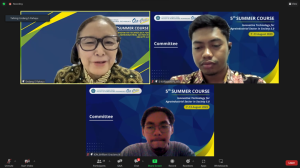
This morning, August 4th 2024, at 10.30 Western Indonesia Time (GMT+7), marked the official opening ceremony of the Summer Course (SC) 2024 held by the Faculty of Agricultural Technology, Universitas Gadjah Mada.

Dr Agung Putra Pamungkas delivered an opening speech welcoming all the participants from over 15 countries. This year, the SC 2024 carries a theme: Adaptive Technology for Sustainable Agroindustrial Sector in a Response to Climate Change. SC 2024 is a hybrid course consisting of two sessions: pre-course (asynchronous) and course (synchronous). All participants have undergone the pre-course sessions for the last five days from July 29th to August 2nd 2024. During the next seven days, from August 4th to August 10th 2024, the participants will go through course sessions consisting of lectures and trips to the field research station. He hoped the participants would enjoy a productive learning experience on several topics, ranging from on-farm technologies, agroforestry, food processing, food waste recycling and sustainable supply chains.

Dr Wiratni Budhijanto, the Secretary of the Directorate of Partnerships and Global Relations UGM, also gave an opening speech to welcome the participants. She also mentioned the unique position of UGM in Yogyakarta. She hinted at the community’s wisdom in tackling problems of agriculture and climate change using different perspectives: technological, cultural and even spiritual. She also spoke briefly about sharing knowledge, making memories, friendships and possible collaborations in the future.

Professor Dr. Yudi Pranoto, S.T.P., M.P., the Vice Dean of Academic and Student Affairs, Faculty of Agricultural Technology (FAT) UGM, welcomed the participants and officially opened the Summer Course 2024. He also elaborated on the many academic activities in FAT UGM, committing to learning, research and community service excellence.

Two online lectures followed the opening ceremony. The first lecture was on Fecal Microbiota Transplantation (FMT) for Livestock Animals Wellbeing, moderated by Putrika Citta Pramesi, M.Sc. from FAT UGM. Dr Jahidul Islam, Associate Professor from Tohoku University Japan, explained the FMT technologies to alleviate disease incidence and reduce antibiotic usage for curing diseased calves. He elaborated on the possible delivery mechanism of FMT using formulated prebiotics, which can alter dysbiosis in calves. The FMT implementation aimed to restore the balance of gut microbiota and improve the health status of livestock animals.

The second lecture was on Carbon Measurement for Mitigating Climate Change, moderated by Dr Ahdiar Fikri Maulana from Vocational College UGM. Dr Rebecca Hood-Nowotny from BOKU Vienna, Austria, described the essentials of soil as the medium to store carbon. Carbon, in the form of carbon dioxide and methane, contributes to climate change. The biotic elements, such as plants, bacteria and fungi, convert the labile pool of carbon into a stable pool using a mechanism called carbon entombing. She elaborated more on the biotic-mediated contribution of carbon pumps to storing carbon in the soil. Finally, she explained how to increase soil health while also improving the carbon storage in the soil using biochar.
The Final Day of the 5th Summer Course: Innovative Technology for Agroindustrial Sector in Society 5.0

EducationNews ReleaseStudentSummer Course Sunday, 13 August 2023

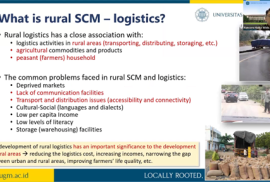
The 5th Summer Course that was organized by the committee from the Faculty of Agricultural Technology, Universitas Gadjah Mada has entered the final day held on August 13th, 2023. This last day of the summer course is the peak of the event. The series of these events first is the session from the speaker Prof. Dr. Kuncoro Harto Widodo, S.T.P., M.Eng. from the Faculty of Agricultural Technology, Universitas Gadjah Mada. The session starts at 07.00 a.m. (GMT+7). The speaker brought up the topic of Smart Logistics for Sustainable Food Sovereignty in Industry 5.0. More about the topic are the food system, food sovereignty, sustainability, smart logistics from concept to evolution, and global trends. From the food system, we got information that the food system wheel consists of the main objective, core system, societal elements, and natural elements. From food sovereignty, we know that food sovereignty does not negate trade, but rather it promotes the formulation of trade policies and practices that serve the rights of people to food and safe, healthy, and ecologically sustainable production. Sustainability has 3 pillars, which are social impact, environmental impact, and economic impact. All of the pillars are connected and related to form sovereignty in the food system. From the industry 5.0 is related to personalization humanization and gives more impact and can be implemented in industry. The last point is smart logistics. The evolution of supply chain management is shifting from one ticket to many tickets. Moreover, a supply network is developed by connecting multiple supply chains. The digital supply chain ecosystem helps us to overcome many problems in the traditional supply chain.

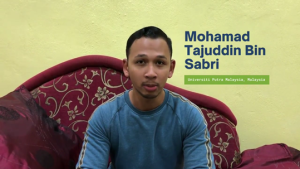
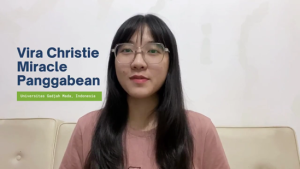
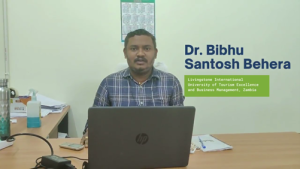
After the session from Prof. Dr. Kuncoro Harto Widodo, S.T.P., M.Eng. all the participants have to do independent study such as material review. While studying independently, the committee prepared for the closing ceremony of the 5th Summer Course. Then, at 10.00 a.m. (GMT+7), was the closing ceremony. The closing ceremony session opened with the closing remarks by Dean of the Agricultural Technology Faculty of Universitas Gadjah Mada, Prof. Dr. Ir. Eni Harmayani, M.Sc. After that, the closing remark from Alfatika Aunuriella Dini, S.H., M.Kn., Ph.D. from the Head of Office of International Affairs, Universitas Gadjah Mada. Then from the Head of Committee 5th Summer Course, Makbul Hajad, S.T.P., M.Eng., Ph.D. played the closing video of 5th Summer Course. Inside the video, there are speeches of impression messages from Dr. Bibhu Santosh Behera from Livingstone International University of Tourism Excellence and Business Management, Zambia; from Mohamad Tajuddin bin Sabri from Universiti Putra Malaysia, Malaysia as a participant; from Vira Christie Miracle Panggabean from Universitas Gadjah Mada, Indonesia as a participant.


Impression Messages from Dr. Bibhu Santosh Behera (India)
Impression Messages from Mohamad Tajuddin bin Sabri (Malaysia)
Impression Messages from Vira Christie Miracle Panggabean (Indonesia)


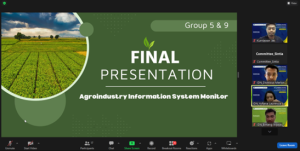
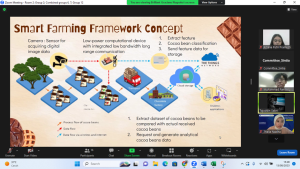
After the closing video, the 5th Summer Course has been closed. However, all the participants continued to the next session with their final presentation with their group. All the participants were divided into three breakout rooms. Each group was waiting for their turn to present the group discussion results. All of the groups were enthusiastic to present their results. After all the groups presented their results, the 5th Summer Course Faculty of Agricultural Technology Universitas Gadjah Mada.

Group final presentation in the first breakout room
Group final presentation in the second breakout room


SMART AND APPLICABLE AGRO-INDUSTRY TECHNOLOGIES

EducationNews ReleaseStudentSummer Course Saturday, 12 August 2023

The 6th day of the 5th Smart Agro-industry Summer Course was held successfully on August 12th, 2023. On this day, two national and two international speakers participated in online lectures. The first session was by Prof. Dr. Eng. Kuwat Triyana, M.Si., from the Faculty of Mathematics and Natural Sciences UGM and Anggoro Cahyo Sukartiko, S.T.P., M.P., Ph.D. as the moderator. The next session was by an Indonesian researcher from the Research Center for Food Technology and Processing, National Research and Innovation Agency (NRIA – BRIN), Dr.rer.nat. Andri Frediansyah, S.Si., M.Sc. and moderated by Imam Bagus Nugroho, S.Si., M.Sc. The afternoon session continued with talks of Prof. Kune-Muh Tsai from the National Kaohsiung University of Science and Technology. The moderator on duty was Moh. Wahyudin, S.T.P, M.Sc. The closing session was a lecture by Dr. Edita Jurak from the Faculty of Science and Engineering, The University of Groningen, while Imam Bagus Nugroho, S.Si., M.Sc. led the discussion.

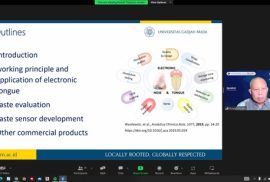
The topic of Prof Kuwat’s lecture was Smart Sensors Technology and Development for Implementation in Agro-Industry. He started his explanation by introducing one of Universitas Gadjah Mada’s great inventions during the COVID-19 pandemic, GeNose, the sensor technologies for detecting COVID-19 patients. After that, he tried to explain the working principle and the application of the electronic tongue (e-tongue) and elaborated it well on the food system, as the technology is a versatile tool in food analysis, enabling accurate and objective assessment of taste and flavor attributes. The applications extend across quality control, safety monitoring, product development, authenticity verification and even environmental analysis.

The Session of Prof. Kune-Muh Tsai from the National Kaohsiung University of Science and Technology

The lectures on the 6th day were not only about artificial intelligence technologies and e-tongue, but they were also about food microbiology and biotechnology. The next session was by Dr.rer.nat. Andri Frediansyah, S.Si., M.Sc. on Food Processing Using Microbes: From Lab to Industry. To give a basic understanding, he explained the basic concept of microbiology and the role of microorganisms in food fermentation as one of the oldest methods for transforming and preserving food in the industry. In addition, he also explained the challenges that probiotics had to face as fermentation products with high levels of demand. The microbial revolution in the food industry using cutting-edge omics technologies has been the way of overcoming the challenge of expansion from lab to industrial scale.


The Session of Prof. Dr. Eng. Kuwat Triyana, M.Si. from the Faculty of Mathematics and Natural Sciences, UGM.

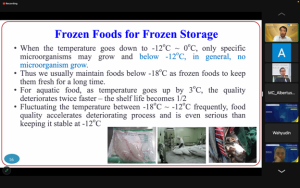
The first of two last sessions after lunch break was a lecture by Prof. Kune MuhTsai on Supply Chain Innovation for Sustainable Food Logistics. He brought up the challenges from farm to table to serve fresh food without losing food and producing waste. Although the lecture was not straightforward to the core of the topic, he tried firstly to give the basic concept of temperature control and cold storage. The cold storage concept was considered good ammunition for innovation creation. He also talked about the regulation and food safety aspect to ensure that the food from this supply chain can sustain. The session ended with study cases prepared by the professor to build up the way of thinking and applicable solutions for the supply chain in food logistics.


The Session of Dr. Edita Jurak from the Faculty of Science and Engineering from University of Groningen

The last session for the 6th day of the 5th Summer Course was another scope of microbiology and biotechnology for industrial implementation. The title was Plant Biomass-based Product Engineering by Microbial Enzymes Application, delivered by Dr. Edita Jurak. There were three main parts of the lecture: first, microbial gene clusters that work together in concert to degrade and modify complex polymers (biomass and plastic). She elaborated further on degrading polymers that require simultaneous microbial gene expression for enzymatic catalysis. She ended her session by giving examples of sources of novel enzymes for biocatalysis.

AGRO-TECHNOLOGY ALTERNATIVES TO ACHIEVE SUSTAINABLE COUNTRY

EducationNews ReleaseStudentSummer Course Friday, 11 August 2023

The 5th day of the 5th Smart Agroindustry Summer Course was held successfully on August 11th, 2023. On this day, one national speaker and three international speakers participated to give an online lecture. The first session was presented by Riza Arief Putranto, PhD from Indonesian Research Center for Biotechnology and Bioindustry and the discussion was led by Inasanti Pandan Wangi, S.T as the moderator. The next session was presented by a Indonesian researcher who work at Research Institute for Humanity and Nature (RIHN) Japan, Andi Patiware Metaragakusuma, Ph.D and moderated by Megita Ryanjani Tanuputri, S.T.P., M.Sc., Ph.D. The afternoon session then continued with Prof. Tsai-Chi Kuo from National Taiwan University of Science and Technology as the speaker and the discussion was moderated by Thalia Naziha, S.T.P., M.Sc., M.B.A. Last but not least, the interesting closure session was a lecture by Assoc. Prof. Pornthipa Ongkunaruk, Ph.D. from Kasetsart University Thailand and the discussion led by Rendayu Jonda Neisyafitri, S.T.P., M.Sc.

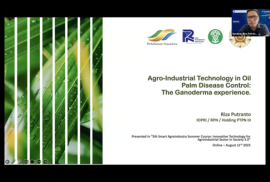
Today’s session started with a topic that is highly related with one of the highest Indonesian cultural plants commodities, palm tree. Riza Arief Putranto, PhD brought “Agro-Industrial Technology in Oil Palm Disease Control: The Ganoderma Experience” for the live lecture. He explained well from the basic concept about Ganoderma disease until the advanced technology that could apply to control this oil palm disease. Moreover, not only talked about the integrated pest control for Ganoderma disease and the insertion of detection technology, but he also tried to elaborate it to the future gene of planting materials. Furthermore, Mr. Riza was not only lecturing, but he left with great messages for us that remind us about how important integrated pest control is for Ganoderma, yet, it was still facing the strictly implemented challenge due to the several protocols that have to follow. Besides that, he also encouraged us to find the curative treatment for BSR/USR, even though it is tricky.

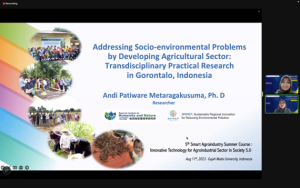
After relaxing for a while, the participants served with the next incredible session that talked about “Addressing Socio-environmental Problems by Developing Agricultural Sector: Transdisciplinary Practical Research in Gorontalo, Indonesia”. Andi Patiware Metaragakusuma, Ph.D. detailed the topics with the explanation from the introduction to RIHN and SRIREP Project. She elaborated the topic with socio-environmental problems in ASGM (Artisanal and Small-scale Gold Mining) areas. The session ended by sharing about the developing agricultural sector through transdisciplinary practical research in sorghum because the participants in Gorontalo want sorghum production to support their household economy. By this moment, she also brought up one of Indonesia’s commodities that can be alternative food diversification of rice or carbohydrate, sorghum, hence, it can be excellent food for future sustainability. Otherwise, TDCOPs (Transdisciplinary Community of Practices) sorghum challenges agricultural engineering and agro-industry for sorghum sustainability in the future.
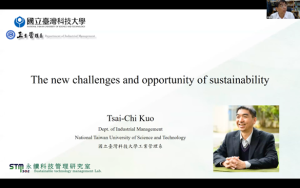
The first of two last sessions after lunch break was a lecture session with Prof. Tsai-Chi Kuo talked about “The New Challenges and Opportunity of Sustainability”. He brought the topics up by considering the environmental threats problem. He also mentioned Sustainable Development Goals (SDGs). The session ended with study cases prepared by the professor to build up the way of thinking and making strategy for implementation of smart supply chains.


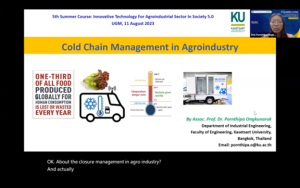
The last session for the 5th day of the 5th Summer Course was “Cold Chain Management in Agroindustry” by Assoc. Prof. Pornthipa Ongkunaruk, Ph.D. The background to this topic was due to food loss, which is also the world’s main problem. She started the explanation with shared data about food loss quantification in Thailand and tried to analyze the possible causes of food loss in a food supply chain. The lecture also connected the issue with food safety and found that the concerns of this issue is temperature, and finally brought back to the topic well by knowing that cold chain management is a great alternative to the food loss problem in agroindustry. In addition, she also elaborated the topics with the recent research and recommendations of best practices in cold chain management.


A Better Future: advancing nutritional food and its packaging

EducationNews ReleaseStudentSummer Course Thursday, 10 August 2023

The 4th day of the 5th Summer Course was held on August 10, 2023. The Summer Course began at 07.15 and consisted of 4 sessions. The first and second session was presented by Rachma Wikandari, S.T.P., M.Biotech., Ph.D. and Prof. Dr. Ir. Endang Sutriswati Rahayu, M.S., moderated by Stugestus Kurniawan Jati, S.T.P., M.Sc. Later, the third session was presented by Assoc. Prof. Dr. Santad Wichienchot and moderated by Inasanti Pandan Wangi, S.T. and lastly the fourth session was presented by Shivani Pathania, Ph.D and moderated by Ashri Nugrahini, S.T.P., M.Sc.

The Role of Filamentous Fungi in Advancing the Development of Sustainable Circular Bioeconomy was the topic that was presented by Rachma Wikandari, S.T.P., M.Biotech., Ph.D. in the first session. She presented the various benefits of filamentous fungi. Filamentous fungi are usually used in foods such as tempeh, soy sauce, natto, miso, blue cheese and others. In addition, filamentous fungi can be used to make mycoproteins. Mycoprotein is an alternative, nutritious protein source with high fiber content and meat-like texture made from a fungal mycelium. In the future, mycoprotein can be used as a meat analogue.

After the first session ended, it was followed by showing videos about chocolate and some Indonesian food. The video playback lasted about 30 minutes. After watching the video, the participants joined a breakout room, which consisted of 12 groups. In the breakout room they had a discussion about the video.

Questions and Answer Session with Prof. Dr. Ir. Endang Sutriswati Rahayu, M.S.

The second session was held at 10 am. The topic for the second session was The Role of Microorganisms in Food Biotechnology and Human Health: Lactic Acid Bacteria. In this session, Prof. Dr. Ir. Endang Sutriswati Rahayu, M.S. presented about lactic acid bacteria. Lactic acid bacteria are gram-positive bacteria that produce lactic acid during their metabolism. In the process of metabolism, lactic acid bacteria convert sugar into lactic acid, causing food products to turn sour and fermented. These fermented foods give a benefit for human health. Some of the benefits are improved digestibility, improved nutritional value, improved lactose utilization and others. In the future, lactic acid bacteria can be utilized for human health.


After a break, the 5th Summer Course was continued with the third session. Third session presented by Assoc. Prof. Dr. Santad Wichienchot. The topic of the third session was Innovative Technology for Developing Functional Food from Local Resource. In this session, Assoc. Prof. Dr. Santad Wichienchot explained about several technologies to improve functional food.

Speakers and material presented in the third session

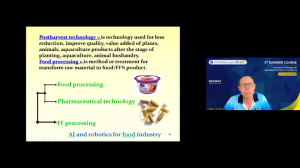
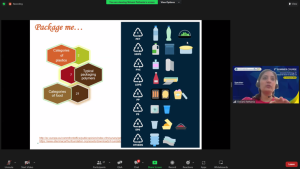
The fourth session was presented by Shivani Pathania, Ph.D. Circular Approach to Food Packaging: Recycable to Compostable was the topic in this session. Shivani Pathania, Ph.D explained about packaging in food. As we know, when buying food we certainly got the packaging, but the packaging can be a problem. Packaging can cause damage to the environment because it becomes pollution. A solution that can be done to overcome the problem of waste pollution from packaging is to make it biodegradable.

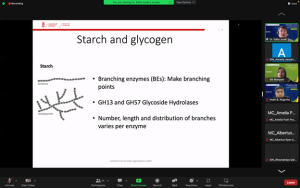
Speakers and material presented in the third session
1…45678

Recent Posts

  • Three DTPB FTP UGM Study Programs Secure ASIIN International Accreditation Through 2030
  • Dari Benih hingga Lahan, FTP UGM dan Sang Hyang Seri Kembangkan Teknologi Pertanian Berbasis Data
  • Learning Across Cultures at Jeonbuk National University, South Korea
  • Beautiful Learning Journey: A Student Exchange at JBNU, South Korea
  • My Experience at Khon Kaen University (TPHP Student Mobility Program)

UGM News

  • UGM’s Youngest Doctoral Graduate Advances Native Chicken Genetics
  • UGM and NTU Host ASEAN Summer School on Renewable Energy and Smart Cities
  • Black Aromatic Ginger and Gotu Kola: UGM Study Finds Potential Herbal Therapy for Optic Nerve Inflammation
  • UGM Researcher Finds Potential Antioxidant and Antihypertensive Benefits in Goat and Sheep Skin Collagen
  • UGM Promotes Green Dentistry Through Free Dental Checkups and Oral Health Education
Universitas Gadjah Mada

UNIVERSITAS GADJAH MADA
FACULTY OF AGRICULTURAL TECHNOLOGY
Jl. Flora No. 1 Bulaksumur
Yogyakarta, Indonesia 55281
+62 274 589797
+62 274 589797
fateta[at]ugm.ac.id

Faculty Information

  • News Release
  • Event
  • Academic
  • Scholarship
  • Job Vacancy
  • Grant

Department

  • Food and Agricultural Product Technology
  • Agricultural Engineering and Biosystem
  • Agro-industrial Technology

Supporting Units

  • Quality Management Unit
  • Agricultural Technology Career Center

Journals

  • Agritech
  • Agroindustrial Journal
  • Indonesian Food and Nutrition Progress

© 2026 Faculty of Agricultural Technology UGM

SitemapPrivacy PolicyContact

KEBIJAKAN PRIVASI/PRIVACY POLICY

[EN] We use cookies to help our viewer get the best experience on our website. -- [ID] Kami menggunakan cookie untuk membantu pengunjung kami mendapatkan pengalaman terbaik di situs web kami.I Agree / Saya Setuju