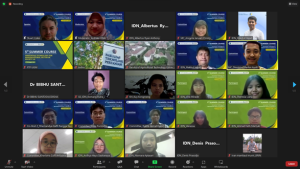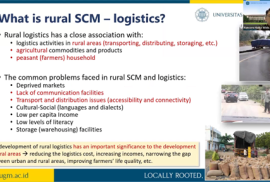
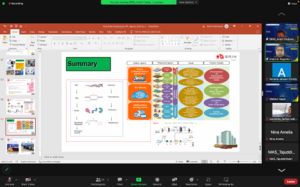
The 5th Summer Course that was organized by the committee from the Faculty of Agricultural Technology, Universitas Gadjah Mada has entered the final day held on August 13th, 2023. This last day of the summer course is the peak of the event. The series of these events first is the session from the speaker Prof. Dr. Kuncoro Harto Widodo, S.T.P., M.Eng. from the Faculty of Agricultural Technology, Universitas Gadjah Mada. The session starts at 07.00 a.m. (GMT+7). The speaker brought up the topic of Smart Logistics for Sustainable Food Sovereignty in Industry 5.0. More about the topic are the food system, food sovereignty, sustainability, smart logistics from concept to evolution, and global trends. From the food system, we got information that the food system wheel consists of the main objective, core system, societal elements, and natural elements. From food sovereignty, we know that food sovereignty does not negate trade, but rather it promotes the formulation of trade policies and practices that serve the rights of people to food and safe, healthy, and ecologically sustainable production. Sustainability has 3 pillars, which are social impact, environmental impact, and economic impact. All of the pillars are connected and related to form sovereignty in the food system. From the industry 5.0 is related to personalization humanization and gives more impact and can be implemented in industry. The last point is smart logistics. The evolution of supply chain management is shifting from one ticket to many tickets. Moreover, a supply network is developed by connecting multiple supply chains. The digital supply chain ecosystem helps us to overcome many problems in the traditional supply chain.
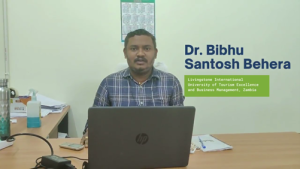
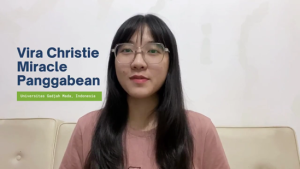
After the session from Prof. Dr. Kuncoro Harto Widodo, S.T.P., M.Eng. all the participants have to do independent study such as material review. While studying independently, the committee prepared for the closing ceremony of the 5th Summer Course. Then, at 10.00 a.m. (GMT+7), was the closing ceremony. The closing ceremony session opened with the closing remarks by Dean of the Agricultural Technology Faculty of Universitas Gadjah Mada, Prof. Dr. Ir. Eni Harmayani, M.Sc. After that, the closing remark from Alfatika Aunuriella Dini, S.H., M.Kn., Ph.D. from the Head of Office of International Affairs, Universitas Gadjah Mada. Then from the Head of Committee 5th Summer Course, Makbul Hajad, S.T.P., M.Eng., Ph.D. played the closing video of 5th Summer Course. Inside the video, there are speeches of impression messages from Dr. Bibhu Santosh Behera from Livingstone International University of Tourism Excellence and Business Management, Zambia; from Mohamad Tajuddin bin Sabri from Universiti Putra Malaysia, Malaysia as a participant; from Vira Christie Miracle Panggabean from Universitas Gadjah Mada, Indonesia as a participant.

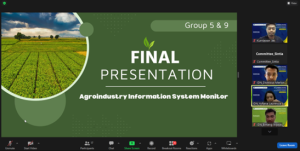
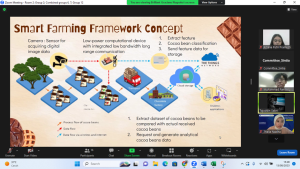
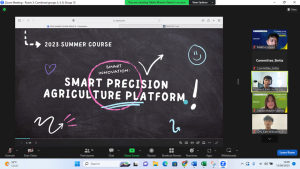
After the closing video, the 5th Summer Course has been closed. However, all the participants continued to the next session with their final presentation with their group. All the participants were divided into three breakout rooms. Each group was waiting for their turn to present the group discussion results. All of the groups were enthusiastic to present their results. After all the groups presented their results, the 5th Summer Course Faculty of Agricultural Technology Universitas Gadjah Mada.
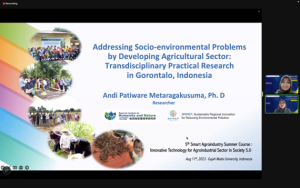 After relaxing for a while, the participants served with the next incredible session that talked about “Addressing Socio-environmental Problems by Developing Agricultural Sector: Transdisciplinary Practical Research in Gorontalo, Indonesia”. Andi Patiware Metaragakusuma, Ph.D. detailed the topics with the explanation from the introduction to RIHN and SRIREP Project. She elaborated the topic with socio-environmental problems in ASGM (Artisanal and Small-scale Gold Mining) areas. The session ended by sharing about the developing agricultural sector through transdisciplinary practical research in sorghum because the participants in Gorontalo want sorghum production to support their household economy. By this moment, she also brought up one of Indonesia’s commodities that can be alternative food diversification of rice or carbohydrate, sorghum, hence, it can be excellent food for future sustainability. Otherwise, TDCOPs (Transdisciplinary Community of Practices) sorghum challenges agricultural engineering and agro-industry for sorghum sustainability in the future.