
The 5th Summer Course’s second day held on Tuesday, August 8th, 2023. The first session was opened by Dr.Eng. Herianto, S.T., M.Eng., IPU., ASEAN Eng. from Faculty of Engineering, Universitas Gadjah Mada as a national speaker. The main topic of the speaker is 3D Printing for Chocolate. The process of 3D printing is made layer by layer or additive manufacturing. 3D printing is started with a CAD model and then transformed into a 3D object in some steps and techniques. The participants were so enthusiastic and it showed in a question-and-answer session. The participant and the speaker discussed the 3D food printing treatment if there are any characteristics. The speaker talked more about the treatment of 3D food printing according to the material, compounds. It brings a different process, different material, so different machines to create the 3D printing product. The conclusion from Mr. Herianto is that the technology of food printing can represent a remarkable innovation because the potential of the technology can revolutionize various aspects of the culinary and food industry and also can anticipate a future where it has a pivotal role in producing, consuming, and experiencing food.
After the first session, the participants joined the breakout room to discuss with their group. The topic of discussion is commodity or industry and gives ideas of technology innovation that can bring up and push the agroindustrial sector in society 5.0. All the participants were divided into 12 groups. All groups have approximately 30 minutes to discuss and brainstorm their topic. In this discussion session, the participants can develop their analytical thinking skills to brainstorm and analyze the idea from the perspective of its strengths, weaknesses, opportunities, and threats of the technology.
The series on the second day of the 5th Summer Course is continued by the second session speaker from Dr. Winny Routray from National Institute of Technology of Rourkela. The main topic discussed in this session is food engineering and post-harvest processing of spices. This topic is talked about spices, which is a product that has a lot of functions such as adding flavor and scents to foods. The product is made from spices such as essential oil. The highest exporters of spices are India, Vietnam, China, Indonesia, and Madagascar, while the highest importers of spices are USA, Germany, and Vietnam. Another important part of optimizing spices products is the packaging. The packaging must consider moisture, oxygen, aroma loss, hygroscopic in nature, pest attack, and weeds in the rainy season. The packaging may contain polyethylene linen and double gunny for bulk packaging. To sustain the production of the spice in the field, some toxins can affect the product such as mycotoxin (ochratoxin), and factors from pre-harvesting, harvesting, and post-harvesting. The solution by the advanced processing method of whole spices, spices powder, and paste such are the drying process using microwave and sterilization process using gamma rays, hydrostatic high pressure, and low-pressure cold plasma. This second session is closed by the certificate submission documentation with the speaker.
The lecture was continued by Dr. Suchada Rianmora from SIIT, Thammasat University, Thailand. The main topic in this session is the product design approach for the agroindustrial sector. The speaker explained that the key considerations of product design and development are to set up “the reference” situation, identify “key components or objects”, and create “a conceptual design” by starting a new journey of product design and development. Also, the participants have new insight and knowledge about developing products and minimizing the gap between high technology and the user in reality. In the processes to develop product design, there are some tools and equipment that can be used such as robots, remodifying and development, and supporting customer satisfaction. Implementation in reality we can do a site survey to take examples and find the case studies. The conclusion in this topic is we should understand and know what the customer needs or should be customer-centric. After that, some participants offered some questions to be discussed with Dr. Suchada Rianmora. All of the elaboration from the speaker gives more perception to the participants.
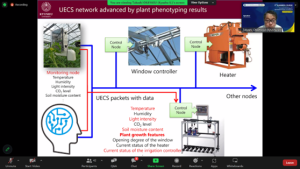
The last session on the second day of the 5th Summer Course was filled by Prof. Takashi Okayasu, Ph.D. from the Department of Agroenvironmental Science, Faculty of Agriculture Kyushu University. The main topic is talked about plant phenotyping technology to promote data-driven agriculture. Moreover, this topic is UECS network advanced by plant phenotyping results which are correlated between the monitoring node (temperature, humidity, light intensity, CO2 level, and soil moisture content) and plant phenotyping sensor node (image analysis). The system also has connections with a window controller, heater, and irrigation controller. Each connection has a control node and was integrated.
At the end of this day, all the participants do the post-test at UGM’s E-Learning system (e-LOK). Then, the participants can continue the discussion with their group work and do independent study such as material review on this day and essay writing submission. They have to prepare for the third day and always check all of the assignments at e-LOK.
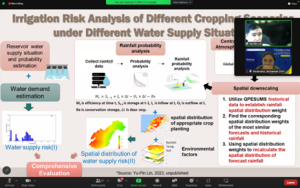

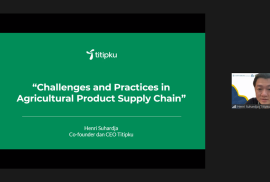
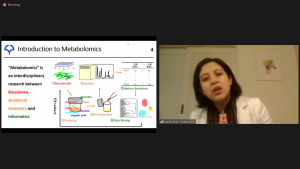 The second session we discussed about
 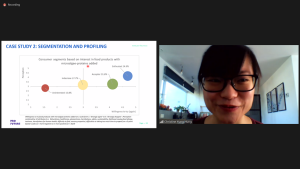 The last session was delivered by Prof. Christine Yung Hung, Ph.D. The topic was about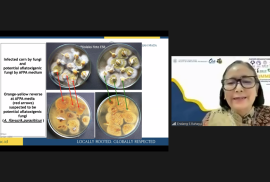
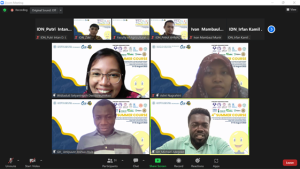 The series of events on the fourth day started at 07.55, which started with an opening by the master of ceremonies. Then continued with the first session by Dr. Widyastuti Setyaningsih, S.T.P. with “Application of experimental designs to develop analytical methods for bioactive compounds in foods” as topic. This session was also accompanied by Ashri Nugrahini, S.T.P., M. Sc.. Dr Widyastuti starts the topic with how bioactive compounds in rice can be separated with chromatographic methods. And then this method can be replaced with other experimental designs. The experimental design can be applied using analytical extraction techniques, namely MAE and PLE and analytical separation techniques, namely HPLC-PDA and UPLC-PDA-FD.
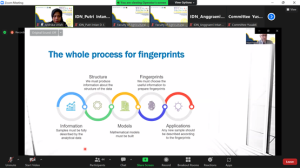 In the third session, Prof. Miguel Palma explained the material about Chemometric Tools in Food Analysis : from Numerical Data to Fingerprints. This session was moderated by Ardhika Ulfah, S.T.P., M.Sc.. Prof. Miguel Palma, in this session begins with an explanation regarding the analysis of the web browser’s working system so that it can meet the needs of its users through the collection of user behavior data. This can be applied to the food industry by collecting data so that fruit or vegetables can be sorted without touching or damaging them based on an existing data base. Another use in the food industry is that fingerprints enable simple, fast, and automated answers that can assist identification and quality control in food companies.
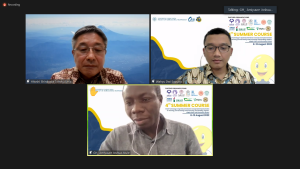 The first session was presented by Prof. Tsuyoshi Okayama, entitled Smart Agriculture Implementation in Japan. In this session, accompanied by Dr. Mirwan Ushada, S.T.P, M.App.Life Sc. as a moderator, Prof. Tsuyoshi explained the agricultural situation in Japan, agricultural machines with autopilot technology, and drone functions in Japan. Japan is experiencing a decrease in the number and aging of farmers, with an increase in the area of ??land per farmer each year. The development of smart agriculture consisting of automation of agricultural machines, agricultural management systems, and 5G internet can ease the workload of farmers and increase the quality and quantity of production. In addition, Prof. Okayama also presented about robots and agricultural services used by Japan. The robot shown is a robot that is used to cut grass and harvest asparagus using image recognition. The agricultural service presented was Raas, a service robot that aims to be rented and paid for according to the harvested production.