
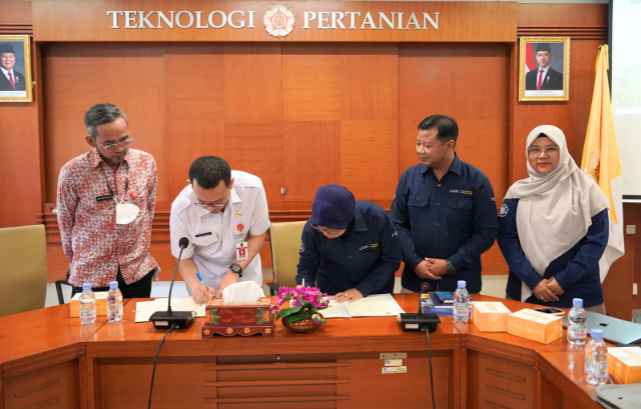
The Faculty of Agricultural Technology (FTP), Universitas Gadjah Mada (UGM), strengthened collaboration with the Regional Research and Innovation Agency (BRIDA) of Semarang City through the signing of a Cooperation Agreement (PKS) and a Self-Managed Cooperation Contract, followed by a follow-up discussion on the “Study on the Development Potential of Urban Gastronomy in Semarang City,” held on Wednesday (5/8) at the Operation Room, FTP UGM. The collaboration marks an initial step toward a research-based study aimed at strengthening Semarang’s flagship culinary products as part of the city’s branding strategy and creative-economy development.
In the discussion, Head of BRIDA Semarang City, Dr. Bagus Irawan, S.T., M.T., M.Eng., described gastronomy development as a strategic effort supporting the strengthening of branding for Semarang City’s flagship products in order to accelerate the growth of the creative economy. In addition, Asdani Kindarto, S.Sos., M.Eng., Ph.D., Head of the Research and Development Division at BRIDA Semarang City, emphasized that developing gastronomy requires an approach that looks not only at culinary products, but also integrates cultural values that have so far remained scattered across various narratives. According to him, a strong gastronomic foundation will become an important asset in building the city’s identity. “Good diplomacy begins with the stomach. That’s why strengthening the culinary foundation will make it easier to achieve Semarang’s city-branding goals,” he said.
Responding to this point, Bambang Dwi Wijatniko explained that developing urban gastronomy requires standards capable of preserving both the identity and the quality of regional culinary products. He noted that the process should not stop at cataloguing traditional foods, but must also address food safety, marketing, and product sustainability. “Recipe standardization serves to reinforce a product’s identity. Alongside recipe variation, the key factors that must be addressed are sanitation, branding, and shelf life,” Bambang explained.
He added that one of the requirements for a city to gain recognition as a UNESCO Creative City of Gastronomy is to have at least three flagship culinary products, hold regular seminars, and produce annual reports on culinary product development and activities, noting that seminars and masterclasses are an important part of building a sustainable gastronomy ecosystem.
Prof. Dr. Ir. Eni Harmayani, Dean of FTP UGM, said the planned study would not only identify culinary potential but also produce scientific recommendations that local governments can use to formulate its gastronomy development strategy. The study will focus on co-creation value and existing conditions, culinary diversity as a marker of regional identity, and the history and cultural acculturation that have shaped Semarang’s culinary richness.
Input on the research approach was also offered by Dr. Dwi Larasatie Nur Fibri, who highlighted the importance of developing a comprehensive survey instrument and applying analytical methods suited to processing data at a macro scale. She added that structured culinary documentation is an important step for strengthening the region’s gastronomic identity and raising public awareness of local culinary heritage.
Through this collaboration, FTP UGM, together with BRIDA and the Semarang City Regional Development Planning Agency (Bappeda), hopes to produce a study that not only strengthens Semarang’s culinary identity but also serves as the basis for research-based policymaking in urban gastronomy development. The collaboration is expected to help boost the region’s competitiveness through the preservation of culinary heritage, the strengthening of the creative economy, and the development of gastronomy networks at both the national and international levels.
This activity supports the achievement of the Sustainable Development Goals (SDGs), particularly SDG 11: Sustainable Cities and Communities, through the strengthening of the city’s identity based on its culinary heritage; SDG 8: Decent Work and Economic Growth, through the development of a gastronomy-based creative economy; and SDG 17: Partnerships for the Goals, through collaboration between universities and local government in producing research-based policy.
Contributor : Bernadetta Shella