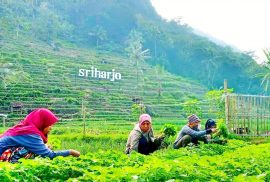
The second day of the 3rd summer course on food with the theme of Local Indigenous Functional Food’s Roles in the Era of Covid-19 Pandemic: From Farm to Table was held on July 14th, 2021. On this day, the activity was divided into 3 sessions including virtual trip and discussion, material elaboration, and presentation. In the first session, the participants joined two virtual community visits and discussed the advantages and disadvantages of implementing Agro-ecotourism and the utilization of agricultural machinery from the video.
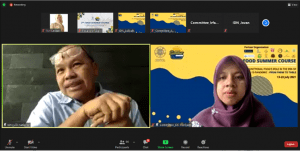 In the second session, the lecture was delivered by Prof. Lilik Sutiarso about “Sustainable Agriculture: a case study in Sriharjo Village”. In his lecture, Prof. Lilik explained about the concept of the bio-circular-green (BCG) economy. The concepts of circular economy, green economy, and bio-economy are joined by the common ideal to reconcile economic, environmental, and social goals. It is a concept that has been developed for a long time. The concept integrates economic, social, and environmental. This concept will provide opportunities including industry, government, and private systems to work together in an interconnected system.
Sriharjo Village is the first village that implements the BCG. Agro-environmental Edu Techno Park [AETP] is a modified model of techno park development that focuses more on agri-environmental systems. AETP environment is the base of a technology-based techno-park. Three aspects were developed in Sriharjo including Agri-environmental Technology, Education Processes, and Enterprise Activity. The output and impact of the AETP model is to sustain agri-environmental system in selected villages, strengthen community knowledge related to agricultural environmental system to build and create community institutions based in agri-environmental system.
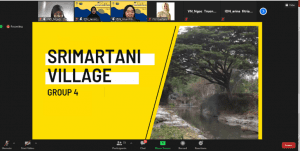 Therefore, the last session was the group presentation based on the results of the brainstorming about the advantages and disadvantages of implementing Agro-ecotourism and the utilization of agricultural machinery of the video that has been conducted in the morning session. This session was guided by Dr. Ngadisih to guide the participant’s group presenting their group discussion regarding the assigned topic by the committee.
 After the opening ceremony continued with 3 sessions of material delivered by Prof. Eni Harmayani, Prof. Unnikhrisnan, and Prof. Gerard Bodeker. The first session was delivered by Prof. Dr. Eni Harmayani, the Dean of Faculty of Agricultural Technology UGM with the topic “Functional Food Development of Local Resources”. In this section, Prof. Eni described the definition of functional food, why are foods called functional food, and functional food from Indonesia. Many local resources can be developed into functional food, such as Glucomannan from Porang, Mocaf from Cassava flour, sweet potato fiber, and Arrowroot flour. Indonesia also has Jamu (Indonesian herbal medicine) and Spices in Indonesia as a functional food.
 In addition, the second session was given by Prof. Unnikhrisnan Payyapallimanna about Indigenous Food Systems in Promotion of Health – An Ayurvedic (Indian) Perspective. Prof. Unnikhrisnan discussed the sustainability challenges of non-communicable, lifestyle diseases, and malnutrition, links between Biodiversity, Nutrition, and Health and the role of traditional knowledge, and elaborated the traditional food systems, their significance in health and nutrition: An Ayurveda perspective. Other than that, Prof. Unnikhrisnan emphasized that “Diversity enriches the quality of life in health, sensory, social, intellectual, and moral terms and increases options and resilience for building livelihoods in the short term and for the future.”
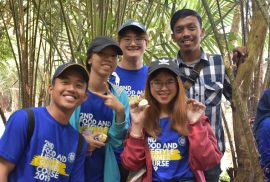
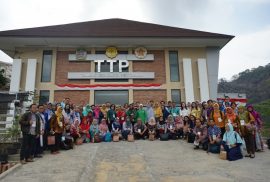

 The participants visited the Agricultural Technology Park (Taman Teknologi Pertanian) located in Gunung Kidul regency, at Nglanggeran village on 30th August 2018. The park was under the authority of Badan Pengkajian Teknologi Pertanian (BPTP) with the assistance from the Faculty of Agricultural Technology of Gadjah Mada University. Dr. Titiek D. Djafaar as BPTP staff presented the introduction of the park and researches held by UGM which were applied for the product development. A traditional performance of gejlok lesung exhibited during the lunch time by the locals also enlivens the impression of Nglanggeran village.
 During the visit, the participants were able to watch the chocolate making process. The Nglanggeran Agricultural Technology Park processes cacao grown by the local people into chocolate candy, chocolate bar, and chocolate powder. Another differentiated products consist of cipiran cokelat, untir cokelat, sale salut cokelat, onde-onde cokelat, and another creative products. The park has an integrated system of the cacao processing by manufacturing the waste in the form of pulp of the cacao fruit to produce mineral blocks used as supplements for goat’s feed. The Etawa goat’s milk is then flavored by the chocolate and sold as chocolate milk powder. It can also be bought as original Etawa goat’s milk.
 Currently, a research about probiotic incorporation using milk as the carrier in chocolate candy is conducted at the park by several fourth-year students of Food and Agricultural Product Technology of UGM with the assistance of Dr. Ir. Tyas Utami, M.Sc and Prof. Dr. Ir. Endang Sutriswati Rahayu. A sensory test of the probiotic chocolate candy was also done with the participants as the panelists.