
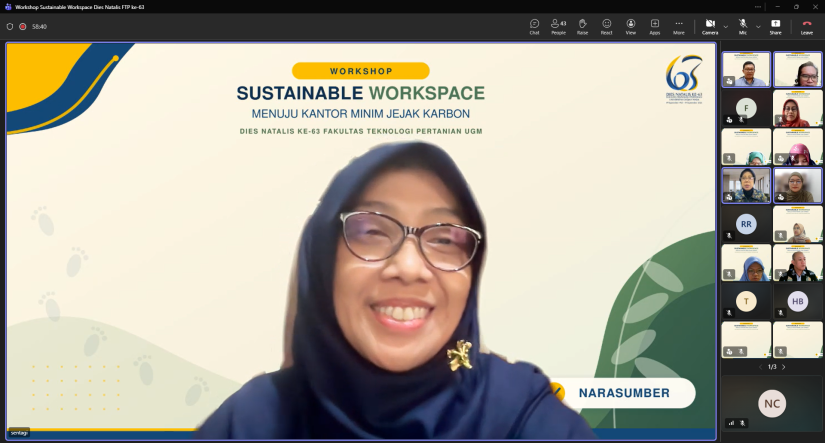
Building a more sustainable work environment requires a change in culture, not just the application of technology. With that spirit in mind, the Faculty of Agricultural Technology (FTP), Universitas Gadjah Mada (UGM), held the “Sustainable Workspace Workshop: Towards a Low Carbon Footprint Office” on Tuesday, July 28, 2026, as part of the series of events marking FTP UGM’s 63rd Dies Natalis (anniversary). The workshop, attended by lecturers and education staff, featured Ir. Sentagi Sesotya Utami, S.T., M.Sc., Ph.D., IPU., as a speaker discussing strategies for building a more environmentally friendly workplace.
Through the workshop, participants were encouraged to understand that the concept of a sustainable workspace is not limited to energy-use efficiency, but also encompasses changes in everyday behavior within the workplace. Various aspects such as reducing paper use, improving waste management, using resources wisely, and adopting working habits that support carbon-footprint reduction form an important part of building a sustainable office.
As a faculty with a strong focus on sustainability issues, FTP UGM believes that the application of environmentally friendly principles needs to begin within its own internal work environment. The workshop therefore served as a discussion space for lecturers and education staff to explore concrete steps that could be applied in day-to-day office activities.
In addition to the presentation of materials, participants also took part in an interactive discussion and workshop session to identify practices with the potential to support the creation of a low-carbon-footprint office. Through this activity, participants were encouraged to exchange ideas and formulate solutions relevant to the needs of FTP UGM’s work environment.
The workshop reflects FTP UGM’s ongoing commitment to developing a work culture aligned with the principles of sustainability. In line with the theme of the 63rd Dies Natalis, the event is expected to raise awareness among the academic community that every individual has a role to play in building a campus environment that is more efficient, healthier, and more environmentally responsible.
This activity supports the achievement of the Sustainable Development Goals (SDGs), particularly SDG 12: Responsible Consumption and Production, through the adoption of more sustainable working practices; SDG 13: Climate Action, through efforts to reduce carbon footprints within the office environment; and SDG 17: Partnerships for the Goals, through collaboration among the academic community in building a sustainable work culture.
Contributor : Bernadetta Shella