
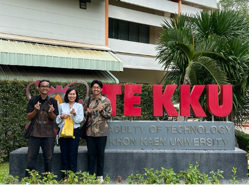
International research collaboration offers more than access to a new laboratory and a new set of equipment. It’s also a chance to see how far an idea travels outside the institution where it started. Khon Kaen University in Thailand turned out to be a good place to test that, both academically and personally.
From January 19 to May 18, 2026 I carried out part of my undergraduate thesis research at Khon Kaen University (KKU), Thailand, representing the Department of Food and Agricultural Product Technology (TPHP), Faculty of Agricultural Technology, Universitas Gadjah Mada (UGM). The research looked at how roasting conditions affect the functional properties of Wolffia spp., a freshwater plant often described as among the smallest flowering plants on Earth and was carried out under the joint supervision of Prof. Dr. Ir. Djagal Wiseso Marseno at UGM and Asst. Prof. Peerapong Wongthahan at KKU’s Department of Food Technology, Faculty of Technology. The placement was supported by research funding from the Office of International Affairs (OIA), UGM.
Academic Activities
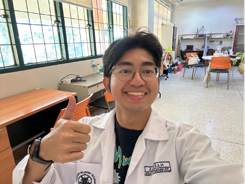
Most of my working hours were split across several labs under KKU’s Faculty of Technology the Food Processing Laboratory, the Pilot Plant Facility, the Food Microbiology Laboratory, and the Food Engineering Research Center, running a 3×3 factorial roasting experiment (three temperatures, three roasting times) on fresh Wolffia spp. Each roasted sample was then analysed for colour, water solubility and absorption, proximate composition, water activity, antioxidant activity, and taste profile using an electronic tongue. The best-performing condition, 160°C for 10 minutes, became the basis for a roasted, powdered beverage concept I named “Hoji-Pham,” inspired by Japanese hojicha. Working alongside Asst. Prof. Peerapong Wongthahan and his lab group also gave me a closer look at how food research gets done in a different academic system.
Non-Academic Activities
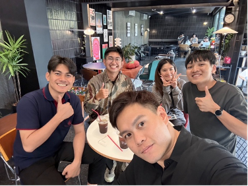
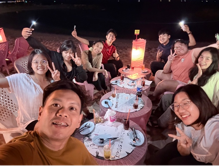
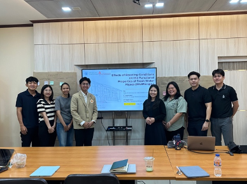
Outside the lab, Khon Kaen kept me fairly busy too. I went to the International Food Festival organised by TE KKU, the Isan Agricultural Fair 2026, and the Jubilee Night Market, and made a habit of jogging around KKU’s campus. My supervisor and a few of the master’s students also walked me around the campus and the surrounding area. A couple of milestones happened along the way I celebrated Eid al-Fitr abroad for the first time, and was in Thailand for Songkran, the Thai New Year celebration. My supervisor and the research team also brought me on a trip to Rayong, and Aj. Nim the supervisor of my fellow UGM student Geronimo, who was doing his own research at KKU at the same time took us to a temple and around some local food spots. Before flying back to Indonesia, I also fit in a short trip to Bangkok.
Benefit
Academically, this placement meant learning new techniques on the spot. Electronic tongue profiling, in particular, was new to me and explaining my experimental choices to a research group outside my usual circle at UGM. Getting feedback from a different research culture pushed the final thesis in directions I don’t think it would have reached otherwise. Settling into a new lab and a new country at the same time took some adjustment, especially around language. Having a Thai mentor made a real difference — for lab conventions, everyday logistics, and the Thai-language conversations I couldn’t quite manage in English on my own. Three months was also long enough to get a feel for daily life in Khon Kaen beyond the lab. The food, the festivals, the general pace of things. Celebrating Eid so far from home for the first time, and being there for Songkran, are two moments from this trip I expect to remember for a long time. I’m also leaving with a working relationship with KKU’s Department of Food Technology that I hope continues beyond this one thesis, Asst. Prof. Peerapong Wongthahan and his research group were generous with their time and equipment throughout.
Closing
Looking back, this placement at KKU shaped both my thesis and a good part of how I think about doing research generally. I’d encourage anyone in TPHP considering a research exchange to take the opportunity seriously. The adjustment takes some effort, but what comes back with you is worth it. I would like to convey my gratitude for “Hibah Pertukaran Mahasiswa Internasional untuk Inbound dan Outbound (Skema EQUITY) tahun 2025/2026 Tahap 2” for supporting my exchange activities.
Written and Reported by: Nabil Amali Subandi