
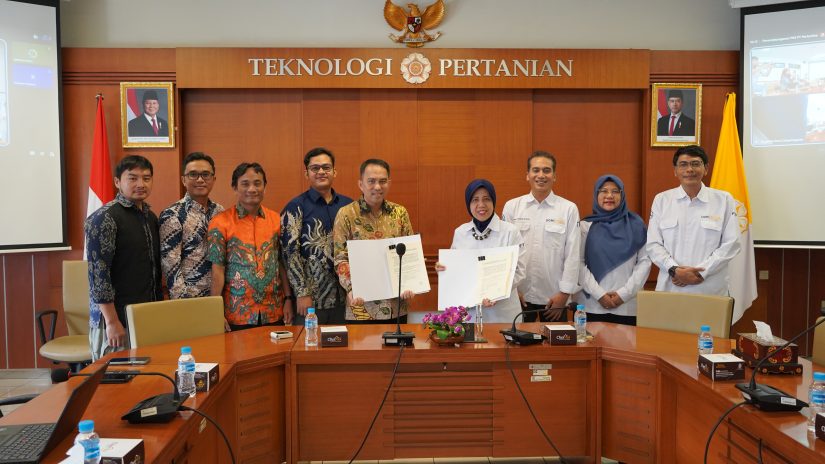
The Faculty of Agricultural Technology (FTP ) Universitas Gadjah Mada (UGM), and PT Pertamina (Persero) officially began a research collaboration to develop high-temperature drilling starch based on sago starch, marked by a contract signing and research kick-off on Monday, June 22, 2026, at the Operation Room, FTP UGM. The event was attended by the Vice President of Technology Innovation, Upstream & Low Carbon, PT Pertamina (Persero), Dr. Ali Sundja, representatives from PT Pertamina and the National Research and Innovation Agency (BRIN), and FTP UGM leadership, marking an initial step forward developing more environmentally friendly, locally sourced drilling materials.
Dean of FTP UGM, Prof. Dr. Ir. Eni Harmayani, M.SC., said the collaboration forms part of a broader effort to strengthen impactful research through synergy among universities, industry, and research institutions. According to her, the development of biodegradable drilling additives opens up opportunities to utilize various Indonesian agricultural commodities, including porang and sago, as functional materials that support the needs of the energy industry while increasing the added value of local commodities.
“Research today needs to be driven toward delivering real impact for industry and society. Collaborations like this create an opportunity to produce innovations that are not only scientifically strong, but also applicable and sustainable,” said Prof. Eni.
On the occasion, the research team presented plans for developing chemically modified sago-starch-based drilling starch as fluid loss reducer for high-temperature drilling operations. The research will run for 12 months, focusing on raw-material characterization, modification process optimization, product characterization, drilling-mud formulation testing, and value-added analysis as the basis for scaling up toward industrial production.
BRIN researcher Yanuar Sigit Pramana explained that Indonesia produces around 85 percent of the world’s sago, yet its utilization remains suboptimal due to its relatively low thermal stability. Through this research, sago starch is expected to be upgraded from a natural commodity into a value-added functional material capable of meeting the needs of the domestic drilling industry.
Beyond supporting the needs of the energy industry, the development of sago-starch-based drilling starch is also expected to reduce dependence on imported materials, strengthen the competitiveness of the national industry, expand the use of sago in non-food sectors, and generated higher economic value for farmers and business in sago-producing regions.
The collaboration between FTP UGM and PT Pertamina (Persero), and BRIN reflects the strengthening of a triple-helix research ecosystem that connects universities, industry, and research institutions in producing innovations ready for downstream commercialization. Through this synergy, the research is expected to generate not only academic output, but also real solutions for a more efficient and sustainable national energy industry.
This activity supports the achievement of the Sustainable Development Goals (SDGs), particularly SDG 9; Industry, Innovation and Infrastructure, through the development of technology based on local resources; SDG 12; Responsible Consumption and Production, through the transformation of sago into a value-added product; SDG 7: Affordable and Clean Energy, through the innovation of more environmentally friendly materials supporting the energy industry, and SDG 17: Partnerships for the Goals, through strategic collaboration among universities, industry, and research institutions.