
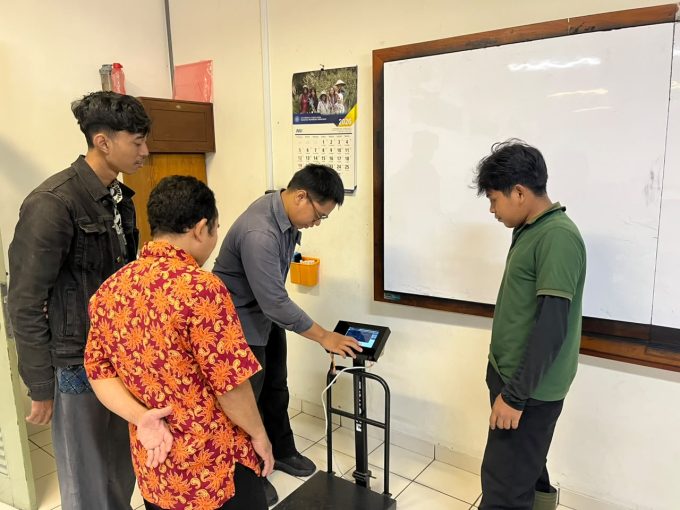
The Faculty of Agricultural Technology (FTP), Universitas Gadjah Mada (UGM), held a socialization session on the use of Internet of Things (IoT)-based waste scales on Monday, July 27, 2026, in Room 102, FTP UGM. The event was attended by the Waste Management Task Force, the Administration, Finance, and General Affairs Working Team, the Asset Team, and the FTP UGM Cleaning Service Team. Through the session, participants were given an understanding of how the IoT-based weighing mechanism works, to support waste management that is more accurate, well-documented, and data-driven.
The session featured Ir. Yakub Fahim Luckyarno, S.T., M.Eng., Ph.D., Yasir Abdulaziz, Muhammad Irfan Abdillah, and Alif Hikmah Kumara Zhali as speakers. In their presentation, it was explained that the IoT weighing system enables real-time recording of waste generation through two main categories: incoming waste and outgoing waste. Incoming waste refers to all waste generated within the FTP UGM environment, while outgoing waste refers to waste that has been sent to processing facilities outside the faculty.
One of the speakers, Alif Hikmah Kumara Zhali, explained that recording both categories is important to ensure the recorded waste-generation data reflects actual conditions.
“If waste is generated at FTP, it must first be recorded as incoming waste. Once that waste is later taken to a processing facility outside FTP, it is then recorded as outgoing waste. This way, the waste-generation data will match actual conditions,” Alif explained.
In addition to the recording mechanism, participants were also given an explanation of the correct weighing procedure needed to produce accurate data. Waste must be placed exactly at the center of the scale on a flat surface to prevent deviations in the weighing results. This operational standard is an important part of ensuring the quality of the data produced by the system.
Alif added that all weighing data would be automatically connected to the university’s server, allowing it to be used as a basis for waste-management policymaking.
“The data will go directly to UGM’s central server. It will then be analyzed as a basis for formulating policy and evaluating waste management across the campus,” he said.
The implementation of IoT-based waste scales at FTP UGM is expected to improve the accuracy of waste-generation data while supporting more effective and sustainable waste management. Through the use of digital technology, the faculty continues to strengthen its data-driven environmental management system as part of its commitment to building a greener, more sustainable campus.
This activity supports the achievement of the Sustainable Development Goals (SDGs), particularly SDG 11: Sustainable Cities and Communities, through the strengthening of waste-management systems within the campus environment; SDG 12: Responsible Consumption and Production, through more effective waste management; and SDG 9: Industry, Innovation and Infrastructure, through the use of Internet of Things technology to support more modern environmental governance.