
National Micro, Small, and Medium Enterprises (MSMEs) Day, observed every August 12, provided momentum for the Faculty of Agricultural Technology (FTP) Universitas Gadjah Mada (UGM), to strengthen the university’s contribution to the development of community-based businesses. This momentum took shape through the National MSME Workshop 2026, organized by UGM’s Directorate of Community Service (DPkM) in collaboration with FTP UGM on Wednesday, August 12, 2026 at the Kamanjani-Soenjoto Auditorium, FTP UGM. Held as part of the series of events marking FTP UGM’s 63rd Dies Natalis, the event brought together around 30 Micro, Small, and Medium Enterprises (MSMEs) actors through a learning forum, experience-sharing sessions, and a product exhibition aimed at strengthening a business ecosystem built on local potential.
The vice Dean for Academic and Student Affairs, FTP UGM, Prof. Dr. Yudi Pranoto, S.T.P, M.P, expressed hope that the event would go beyond a forum or product exhibition and generate broader impact for the community and business actors.
“The hope is that this event won’t be limited to a meeting, a workshop, or a product showcase and networking session. Beyond that, there should of course be a significant impact, especially for the community and for business actors more broadly, at the national level,” he said.
A similar view on the importance of MSMEs to the economy was also shared by UGM’s Vice Rector for Student Affairs, Community Service, and Alumni, Dr. Arie Sjujito, S.Sos., M.Si. According to him, the success of MSMEs is closely tied to the strength of the broader economy, and their development therefore deserves attention and support.
“If MSMEs succeed, I believe our economy will grow strong. But if MSMEs are neglected and given no attention, a decline in that potential is bound to happen.” he said.
Carrying the idea of synergy between community economic institutions through cooperatives and MSMEs, the workshop discussed various strategies for strengthening businesses built on local potential. Cooperatives were seen as capable of driving an ecosystem that supports MSME growth, while MSMEs form an important part of the productive economic activity that sustains cooperatives.
The discussion was enriched by a range of success stories from business actors and academics alike. Amirullah Setya Hardi, S.E., Cand.Oecon., Ph.D., from UGM’s Faculty of Economics and Business Discussed Strengthening cooperative institution as a platform for developing MSMEs’ flagship product. Meanwhile, Dr.Ir. Muhsin Al Anas, S.Pt., IPP., shared his experience with cage-free layer-hen business opportunities for producing omega-3 eggs through a group-based model.
On the side of developing products rooted in local wisdom. Herdiana Dewi Utari of CV Dewi Makmur shared her experience transforming traditional jamu (herbal tonic) into a healthy-lifestyle product and business opportunity. Another perspective was shared by Juni Noor Hastuti, owner of Matahari Craft, on turning corn-husk waste and natural fibers into dried-flower craft and home decor products with high economic value. Lenny Tursia Vishtrina of Evanz Store also shared her experience developing creative ideas to seize market opportunities.
The series of presentations and shared experience were guided through discussion sessions that gave participants the opportunity to exchange views with the speakers. Bayu Nugraha, S.T.P., M.Sc., of FTP UGM served as moderator for the second session, which discussed the selection of production tools and machinery to support economic institutions, along with various business-development experiences.
FTP UGM also contributed directly through a presentation on the selection of production tools and machinery to support economic institutions, delivered by Dr. Ir. Devi Yuni Susanti, S.T.P., M.SC., IPU., ASEAN Eng. This discussion reinforced the perspective that developing MSMEs requires not only creativity in producing goods, but also the right technological support to improve production effectiveness and capacity.
As part of the series of events marking FTP UGM’s 63rd Dies Natalis, the event was also carried out in the spirit of the anniversary celebration, which reinforced FTP UGM’s contribution to the community. Dr. Novita Erna Kristanti, S.T.P., M.P., Chair of FTP UGM’s 63rd Dies Natalis Committee, played an important role in organizing the series of activities linking the Dies Natalis momentum with tangible contributions to the community and business actors.
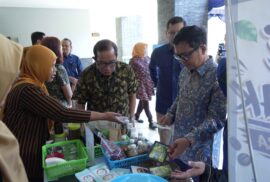
Beyond the workshop and seminar sessions, the event also featured an exhibition of products from mentored MSMEs, held in the courtyard of the Kamarijani-Soenjoto Auditorium, FTP UGM. Around 30 MSMEs took part, showing their respective flagship products. The exhibition provided a space for business actors to introduce their products while opening up opportunities for interaction and networking with participants and other attendees.
The variety of products on display shows that MSMEs potential can grow from a range of local resources, from food and health products rooted in local wisdom to handicraft. Bringing together the experience of business actors, academic perspectives, and institutional support is expected to open up broader opportunities for collaboration in MSME development
For FTP UGM, participation in the National MSMEs Workshop 2026 forms part of the faculty’s commitment to contributing to the development of the community’s economy. Held to coincide with both National MSMEs Day and the series of events marking FTP UGM’s 63rd Dies Natalis, the event is expected to encourage MSMEs to grow, innovate, and move up to a level, while strengthening the community’s economy based on local potential.
This activity supports the achievement of the Sustainable Development Goals (SDGs), particularly SDG 8: Decent Work and Economic Growth, through strengthening the capacity, innovation, and development opportunities of MSMEs, and SDG 17; Partnerships for the Goals, through collaboration between universities, community institutions, and business actors in strengthening the community’s economic ecosystem
